ARTS UNIT OF INQUIRY
THEME: APPROPRIATION AND SUSTAINABILITY LEARNING SEQUENCE .
LESSON 1.
RESPOND - THEORY
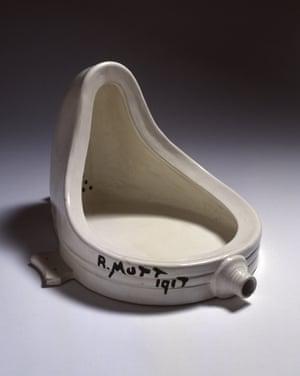
Appropriation is an art movement where artists use something that already exists and claim it to be art or use it in a new artwork. The most famous piece of appropriation art which is a little controversial was an artwork by Duchamp 1917. He titled it Fountain.
-
Why would this have been controversial?
-
What art elements and principles could you use to describe this artwork?
Below is the work of photographer, Jim Golden. He photographs ordinary thing to invite the audience to enjoy them in their not posed ordinary simplicity. The photo below is a collection of objects the artist found on beaches. Alone they hold little interest but viewed as a group they are engaging.

Golden is interested in people and their collections. No item is mundane when viewed together with other possessions.
MAKE - ACTIVITY
Collaborate
-
Students select object from collection provided by teacher and arrange them on a long, narrow table. Teacher photographs arranged work of students for ‘Present and perform’ activity in lesson 5.
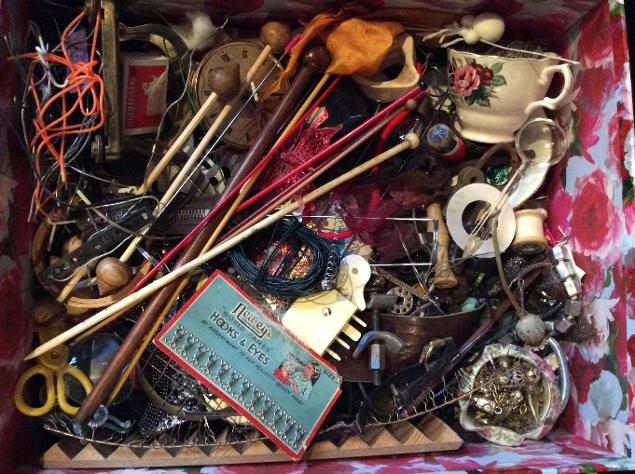
- Students stand by their arrangement and share briefly about it including what appealed to them about these objects.
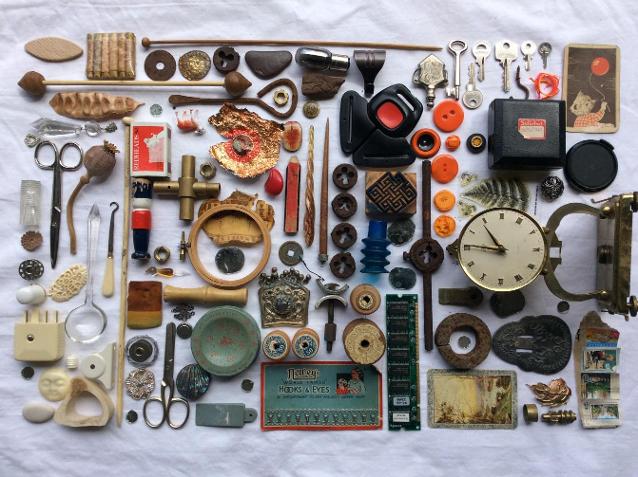
Photograph by Ingrid Schmidt. Arranged paraphernalia.
-
Students photograph their own work and ‘appropriate’ work of other students with photography on devices. Photographs are printed on white and/or coloured paper.
-
Students affect photographed images with pencil, charcoal, acrylic or metallic paint, fine liner pens, collage, hole punching, stitching… to create a new artwork.
-
Students please note, you will be using some of these items for a sculpture that can be suspended (hung) in lesson 4 and 5 for assessment. Please consider what you would like to use and bring to me so I can photograph it with your name.
CURRICULUM LINKS
- Explore how artists manipulate materials, techniques, technologies and processes to develop and express their intentions in art works (VCAVAE041)
- Respond and Interpret
- Analyse and interpret artworks to explore the different forms of expression, intentions and viewpoints of artists and how they are viewed by audiences (VCAVAR045)
DIFFERENTIATION
- Streamline - Choose a colour and arrange objects in this shade on a piece of complimentary coloured paper. Photograph.
- Extend – Students to add 3D objects and/or build up parts of artwork to develop physical depth.
ASSESSMENT
- Photograph students’ object arrangement and also their final artwork after appropriation for diagnostic assessment.
LESSON 2.
RESPOND - THEORY
Appropriation and Sustainability. Artwork on repurposed book pages.
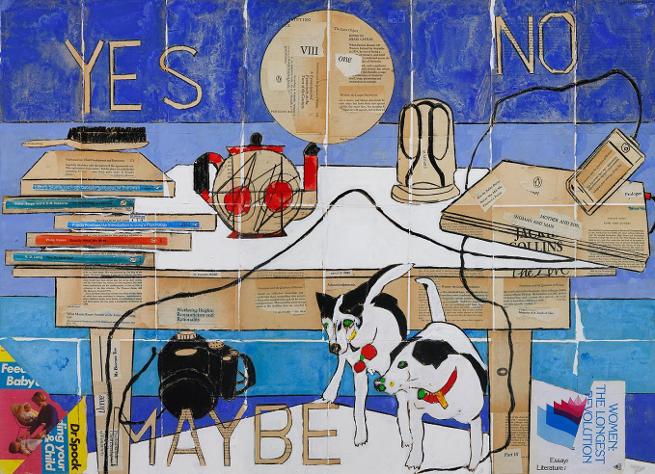
By Katherine Hattam, 2016. Exactly what we want. Materials: gouache, charcoal, collage of book pages and spines on rag paper
- Can you see what this artwork has been created on?
- What art elements and principles has the artist used in creating this artwork?
“Hattam uses personally symbolic materials, such as deconstructed Penguin classics from her late mother’s collection, or unfinished paintings by her artist father, alongside references to family politics, art history and psychoanalysis which hint at hidden meanings and unresolved relationships,” Ms Busowsky Cox said. https://www.deakin.edu.au/about-deakin/media-releases/articles/desire-first-exhibition-surveys-work-of-katherine-hattam
MAKE - ACTIVITY
-
Students work in small groups of 4, 6 or 8, to produce an artwork where they have drawn a section of an image onto 8, 12, or 16 pages of an old book. They compile the artwork when completed. Teacher collects for lesson 5. In keeping with the theme of appropriation and sustainability, the subject matter for these small artworks could be objects from nature, perhaps a tree, a detail of a fish or bird and a crystal geode, representing animal, mineral and vegetable.
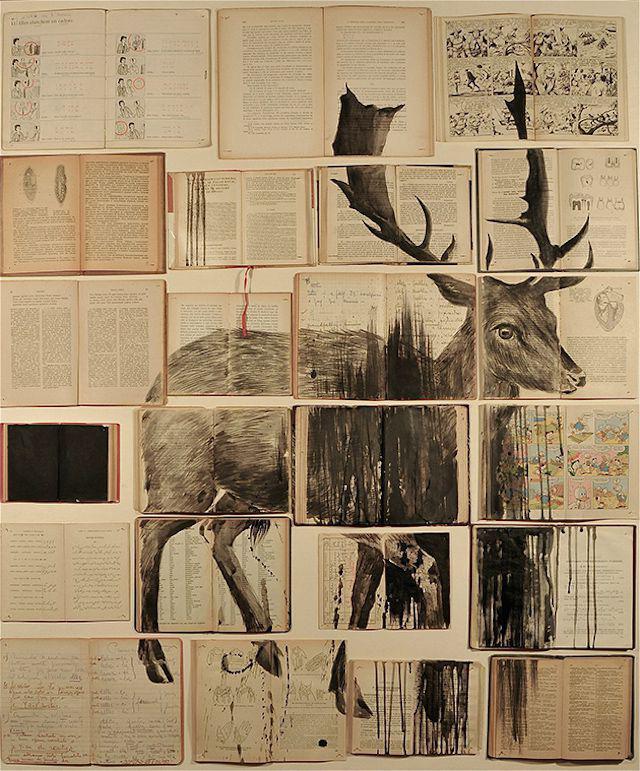
- Students experiment with crayon rubbing, hole punching, collage, mark making....... on pages of old books. Consider format. Artwork could be wide-angle or very tall. From here, they develop an image that conveys something about sustainability and/or waste and/or consumerism.
- Students please note, if you have some interesting old or broken bits and pieces from home that you would like to use in an assemblage artwork we will be starting next week, please bring them into class.
Teacher photographs individual work for diagnostic assessment.
CURRICULUM LINKS
- Explore and express ideas
- Explore the visual arts practices and styles as inspiration to develop a personal style, explore, express ideas, concepts and themes in art works (VCAVAE040)
- Visual arts practice
- Select and manipulate materials, techniques, and technologies and processes in a range of art forms to express ideas, concepts and themes (VCAVAV042)
DIFFERENTIATION
- Streamline – Student directed to read the words on the page and circle ones that interest them. From here, they create a pattern to link the words. Note: the words don’t have to convey meaning necessarily.
- Extend – Students are directed to reconfigure pages of an old book into a concertina artist book.
ASSESSMENT
-
Formative assessment is achieved by talking with students about what they are aiming to achieve.
LESSON 3.
RESPOND - THEORY
Watch the video about Pop Art, Dada and Appropriation.
- What are the two ways objects used in appropriation art used?
- Who was the first artist to use collage?
- In what way was collage a first in art history?
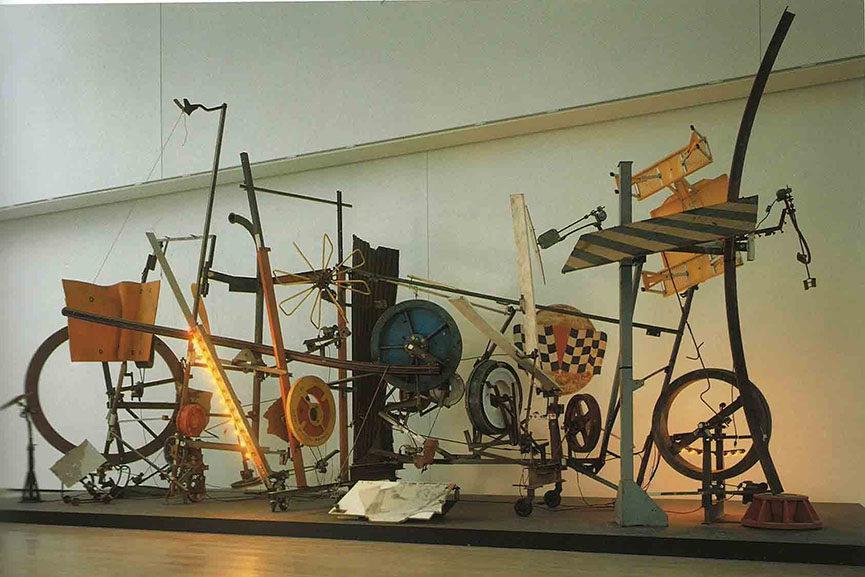
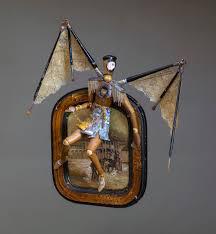
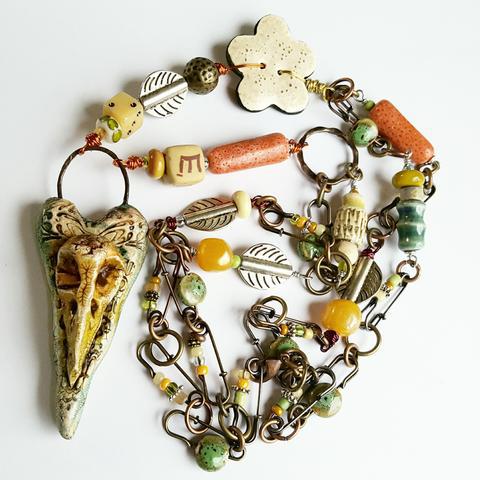
Now watch the You Tube clip about Assemblage art.
- Assemblage art is sustainable art. It also questions the idea of 'what?'
- Does anyone have any questions?
MAKE - ACTIVITY
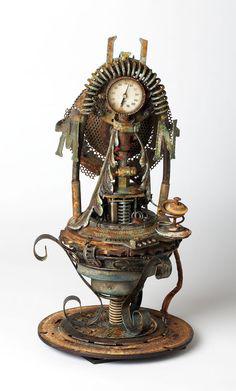
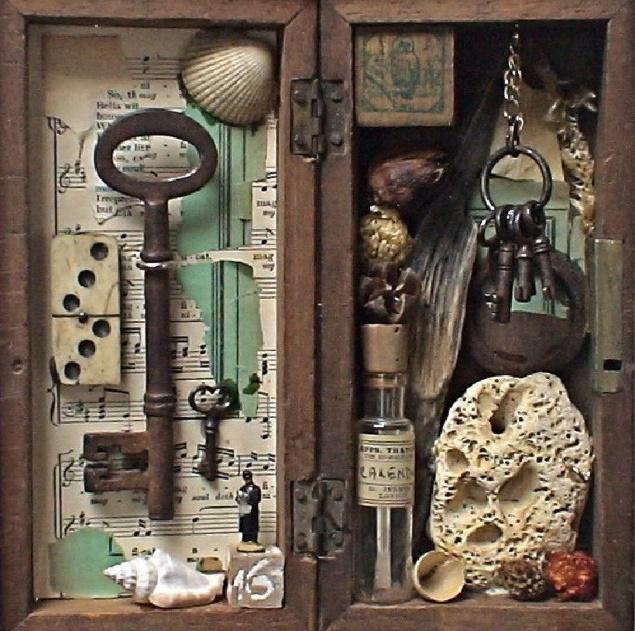
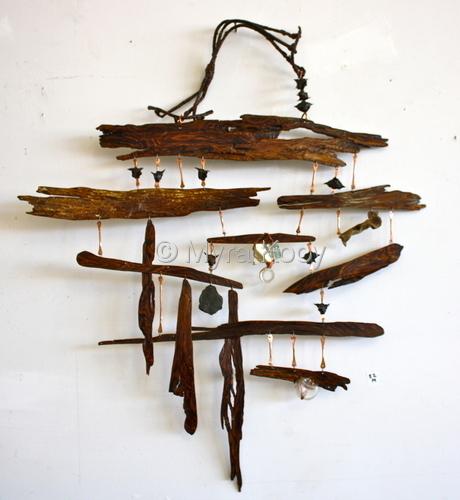
- Preparing for assemblage/junk art task. Lay out available Materials from collected objects as well as fabric, string, wire of varying gauges, washers, sticks, stones, sea glass... Sketch a minimum of two plans. Extend one with annotation.
- Show collage of assemblage images.
CURRICULUM LINKS
Respond and Interpret
-
Analyse, interpret and evaluate a range of visual artworks from different cultures, historical and contemporary contexts, including artworks by Aboriginal and Torres Strait Islander Peoples to explore differing viewpoints (VCAVAR046)
Visual Arts practice
-
Conceptualise, plan and design art works that express ideas, concepts and artistic intentions (VCAVAV043)
DIFFERENTIATION
- Streamline – student directed to screen shot images of suspended sculptures they are interested in for reference.
- Extend - N/A
ASSESSMENT
Formative assessment occurs while students are working on their 3D suspended artwork annotated plans and when they require help.
LESSON 4.
RESPOND - THEORY
Here is a contemporary example of appropriation. Play 70 Million Horses.
MAKE - ACTIVITY
- Students will be working on their assembled art task.
- It is important to allow them to focus on their progress.
- Teacher role is very much facilitator/assistant to students to enable them to create their artwork.
- Students will most likely need to be supplied with wire cutters, scissors, string, thread, glue, etc.
- Project slide show or photo collage of inspiring images (see below).
CURRICULUM LINKS
Visual arts practice
-
Select and manipulate materials, techniques, and technologies and processes in a range of art forms to express ideas, concepts and themes (VCAVAV042)
Present and Perform
-
Create, present, analyse and evaluate displays of artwork considering how ideas can be conveyed to an audience (VCAVAP044)
DIFFERENTIATION
- Streamline – facilitate student to create their artwork.
- Extend – N/A.
ASSESSMENT
- Formative assessment occurs while students are working on their 3D suspended artwork and when they require help.
- Teacher photographs work produced by students for summative assessment.
LESSON 5.
RESPOND - THEORY
-
The Extraordinary World of Art: How to curate an exhibition.
MAKE – ACTIVITY
- The theme is Appropriation and Sustainability.
- This is a showcase of Year 9/10 artwork.
- The exhibition space is the Administration foyer and adjoining hall.
- What were the six points to consider that the presenter conveyed?
- What is the message of the artists? Discuss with your friend for 5 minutes and write it down.
- Students share with the group what they think the group’s message is.
- Each student to put out what they consider their best work from this inquiry.
- The aim is every student will exhibit at least one artwork.
- Students will analyse the collected artwork and collaboratively decide what artwork will be presented.
- Students will curate how artwork will be exhibited in the school foyer. They will consider focal points, artwork groupings and configuration, temporary wall placements and 3D artwork display options to display work to its greatest advantage.
CURRICULUM LINKS
Present and Perform
-
Create, present, analyse and evaluate displays of artwork considering how ideas can be conveyed to an audience (VCAVAP044)
Respond and Interpret
-
Analyse and interpret artworks to explore the different forms of expression, intentions and viewpoints of artists and how they are viewed by audiences (VCAVAR045)
DIFFERENTIATION
- Streamline – student will be directed to plan an alternative exhibition layout in the library.
- Extend – N/A.
ASSESSMENT
Informal assessment would take place as students are observed collaborating and compromising about issues related to exhibiting their artwork.
© Copyright Ingrid Schmidt