‘The artist is not a special kind of person; rather each person is a special kind of artist’. Ananda Coomaraswamy. (The Unbounded Spirit).
What are the Arts and how are they conceptualised in the Victorian Curriculum?
The Victorian Curriculum F – 10 states the Arts includes ‘Dance, Drama, Media Arts, Music, Visual Arts and Visual Communication Design’ (Victorian Curriculum, 2016).
Participating in the Arts education in school is where a child contextualises his or her place in the World; culturally, geographically and historically. Through the Arts, a child is grounded with an accurate perception of themselves, their community, their country and the present time in which they live.
The Arts is the discipline where students have opportunities to express ideas that are important to them with their own unique communication, be it either in the form of performing arts (Drama, Dance or Music) or the production of visual artworks (Media Arts, Visual Arts or Visual Communication Design).
Over the 11 years students are at school, The Arts scaffold acquisition of skills and techniques from contemporary and traditional artistic practices from the students’ own culture, and that of other cultures, and from their present time, as well as our rich human history.
There are four strands of learning within the Arts that are consistently focused on throughout the years between Foundations to year 10. These are (1) Explore and Express Ideas, (2) Arts Practice, (3) Present and Perform, and (4) Respond and Interpret. Alongside the experimenting and refining of skills and techniques (Explore and Express ideas), and producing resolved art works (Arts Practice), students learn to consider appropriate presentation and accurate communication of their artwork to the audience ((Present and Perform). Students also view artwork and performances from the stance of the audience, whereby students respond to and interpret their own art, artwork of others, including their peers, contemporary artists, and artists from by gone eras (Respond and interpret). Through this students gain a deeper understanding and insight into the message of art. Addressing these four strands in their learning, richly establishes in students, the qualities of critical and creative thinking, empathy, sustainability and resilience which have cross curricular learning benefits.
‘Art encourages children to think, developing skills and confidence as they go’. MaryAnn f. Kohl and Barbara Zabarowski. (Authors of ‘Action Art, Hands on Active Art Adventures).
Learning is scaffolded across the years that the Arts are taught at primary and secondary school, and students produce artworks with increasing finesse and sophistication as they participate consistently in consecutive classes.
Present life with all its complexities, challenges and beauty, is normalised and adapted to for the child, through learning in the Arts.
Why are the Arts presented as an essential learning area in a child’s education? Why teach art to children?
It is not surprising that the Arts is one of the essential learning areas in a child’s education when we consider it is at the very core of our humanness and was a discipline being practiced as a form of communication and recreation that existed long, long before literacy and numeracy. Dinham asserts ‘They (the Arts) are integral to human society and archaeologists go so far as to say that our artist practices, along with rituals and new technologies, are the three key drivers in the evolution of humankind’ (BBC News, 2000) (Dinham, 2014, pg.3).
Augustin Fuentes is an Anthropologist who authored The Creative Spark: How Imagination Made Humans Exceptional. In an interview with Simmon Worrell, writer for the National Geographic, Fuentes stated “Without art, we’re not human. The ability to imagine and take that imagination and make it into reality is one of the things that is really distinctive about humans” (Fuentes, National Geographic, 2017). The artwork that students produce through consistent scaffolded learning in the Arts at Primary and Secondary School will inform the people of the future (adults and children alike) of the culture, issues and concerns faced by the people of today, not to mention resolutions to problems we creatively formulated and implemented. An alternative future where art is not richly and consistently taught, and the consequential lack of artworks will reap a population that has taken a step backwards in human evolution, as skills and proficiencies are subdued or lost. We would become less empathic. Less able to solve problems, less able to think creatively and analyse critically. Less Human. Judith Dinham, author of Delivering Authentic Arts Education, states ‘it is interesting to observe that earliest forms of artistic practice and artefacts encapsulate key qualities that still hold today. We regard the arts as being:
-
A feature that distinguishes us as humans
-
A necessary part of our existence
-
An expression and communication of meaning
-
An engagement of our aesthetic sensibilities’.
(Dinham, 2014, pg. 3)
Being educated in the Arts contributes to equipping students for adult life including but not limited to a multitude of arts industry careers, healthy and leisurely practice of creative practices, home maintenance, not to mention parenthood! According to the ‘My Skills’ website, (which is the National Directory of Vocational Education and Training, the Australian Government’s Department of Education and Training), Arts and Culture contributes a gross value of $10.1 billion dollars to the Australian economy (My Skills, dept of Education and Training, 2019).
Arts education plays an enormous roll in enabling diverse learners. The VCAA defines diverse learners as
-
Students with disabilities and additional learning needs
-
English as an additional language
-
Gifted and talented students
(VCAA, diversity of learners, 2016).
Students with disabilities and additional learning needs are provided with opportunity to gain skills to communicate in alternative ways. For the English as an additional language student the Arts are a discipline through which they have an alternative method to communicate. Arts education provides the gifted and talented students satisfying and ample opportunity to expand their education in a method that surpasses academic learning. Receiving education in the Arts provides the diverse learner (and indeed any learner) with agency to communicate their truth in ways that may not otherwise be possible with written words or spoken language.
“I found I could say things with colour and shapes that I couldn’t say any other way – things I had no words for’. Georgia O’Keefe.(Good Reads, 2019).
Aside from the previously mentioned benefits of being educated in the Arts, there lies a satisfaction that occurs as a result of personal pride in producing a resolved artwork with your own hands. Children and adults alike experience delight when they make something creative as they discover, with surprise and delight, the vastness of their capabilities. The confidence of Arts students is ignited through making which inspires them to try new things and have self-assurance that they can solve problems, girding their ability to be resilient. In the document, Creativity in the Primary Curriculum, Grainger and Barnes assert that creativity ‘develops the kind of skills young people will need in a rapidly changing and uncertain world and it can improve their self-esteem, motivation and achievement.” (Grainger and Barnes, 2006, Pg.2).
As Csikszentmihalyi stated, “If too few opportunities for curiosity are available, if too many obstacles are put in the way of risk and exploration, the motivation to engage in creative behaviour is easily extinguished” (1996, Pg.11).
My Arts education experience and its effect on teaching the Arts in education?
I have asked myself, why is it that I make art? It is a difficult question to answer as I can’t imagine NOT making art. I am a visual artist. I make art with my hands and in my mind. I see superfluous material as components of creative projects. The world around me inspires me with ideas for meaningful art lessons to teach, and artworks I am motivated to produce.
Visual art is one of my three great loves, the other two are people and this glorious planet we live on. It is my belief and understanding that these three elements can exist symbiotically, yet there needs to be change for this to happen. I surmise that we as the human race can lay down and wait for our end or we can consciously and deliberately work toward making positive change for ourselves and our planet. What better way to do that than by teaching and informing our children, the inheritors of the world, to have respect for themselves, each other, and the Earth.
“I feel there is nothing more truly artistic than to love people’. Vincent van Gogh. (Good Reads, 2019).
In the process of making art there are two beneficiaries, the maker and the audience. When I am making art, I experience joy. The source of this joy is threefold, I embrace the process of making, and I appreciate what I have made. The confidence I have in my artistic ability brings me joy also.
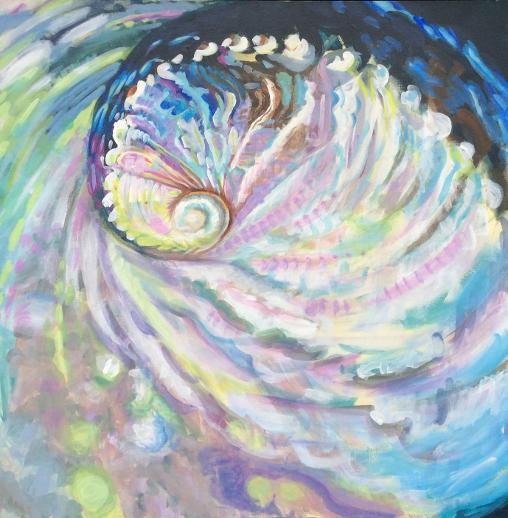
Producing art allows me to influence the world with the issues and beliefs I find of absolute importance. The theme for many artworks in my Bachelor degree focused on the natural world – for example, landscapes at unusual angles, a giant abstract study of the colours in a small shell, a whimsical artist book about little things in nature to notice and appreciate. My aim was to engage the audience so that they might soak in some of the awe and spectacle in nature and reconnect and invest in the natural world.
‘Move me and improve me’ defines what I want my art to do for me and for others. I expect to learn and grow as I make art, and I intend for my art to provoke thought in my audience and trigger change in us all for the better.
Shell Study. By Ingrid Schmidt 2016. Acrylic on Canvas. 90cm x 90cm.
How should the Arts be implemented in primary learning contexts?
Enabling children to be aware of themselves, accept themselves, respect themselves and express themselves is what I see as a major part of my role as an art teacher. When a child is on the path to gaining an accurate perception of themselves they are better able to live a happy life and influence others is a good way. Students also benefit from understanding others people and their cultures, beliefs and opinions as there are many ways of thinking that are different to our own, all of which have merit and deserve respect and acceptance.
Students benefit from being facilitated to enjoy life whilst being considerate of sustainability. Here, a careful balance needs to be struck as reluctance to ‘waste’ materials and resources can extinguish students’ freedom to be creative.
Art facilitated students to enjoy creative practice everywhere including the playground with its endless supply of natural materials. Activating awe and wonder in the natural world around us and creating sustainable and/or biodegradable art, in the cultures of all peoples and knowing, growing and respecting ourselves as well as what is possible to create in the Arts is probably my favourite part of teaching the Arts.
“Art is a place for children to learn to trust their ideas, themselves and to explore what is possible’. MaryAnn F. Kohl. (AZ quotes).
In my art class:
-
Students would have a clear understanding of terms such as ‘trajectory’ and ‘creative processes’ and ‘beauty in imperfection’ in a creative context. These terms would be seen as desirable targets.
-
Students would be facilitated to experience mediums, instruments and skills available to them with traditional techniques as well as giving students opportunities to use these tools in new and unique ways, making creative discoveries for themselves.
-
Students would explore and discern what issues were important to them and what ways they would like to convey their interest.
-
Students would seek out mentor artists and know why their art was important to them.
-
One term every year would be dedicated to making artwork from purely organic matter that was therefore completely biodegradable, to encourage sustainable thinking without having to forfeit any creative avenues.
Art is so closely tied to our evolution. As we are still clearly evolving, it is essential that we empower children to learn in the Arts.
© Copyright Ingrid Schmidt