PREPARATION FOR YEAR 10 STUDENTS THAT ARE PLANNING TO STUDY VCE STUDIO ARTS
Below you will find visual diary pages detailing my ideas about art that can be produced with very little or no negative impact on Planet Earth. I am interested in cyanotype photography that uses the sun for exposure to achieve an image, random weave basketry with environmental weeds and eco dying using a pot of water, copper pipes and flowers to dye natural fabrics like silk, wool, cotton and linen. I am also interested in soft sculpture inspired by Mirka Mora.
Mixed in-between the pages of my visual diary process is a series of art making and responding activities that will prepare year 10 students for VCE Studio Arts. The making activities provide an opportunity to try various art media, materials and techniques that could be used in VCE Studio Arts. The responding activities introduce students to the written aspects of Studio Arts, for example, annotation, arts vocabulary, art elements and principles and aesthetic qualities.
At the very end, you will see my idea for my final art work that combines basketry, doll making and eco dying.
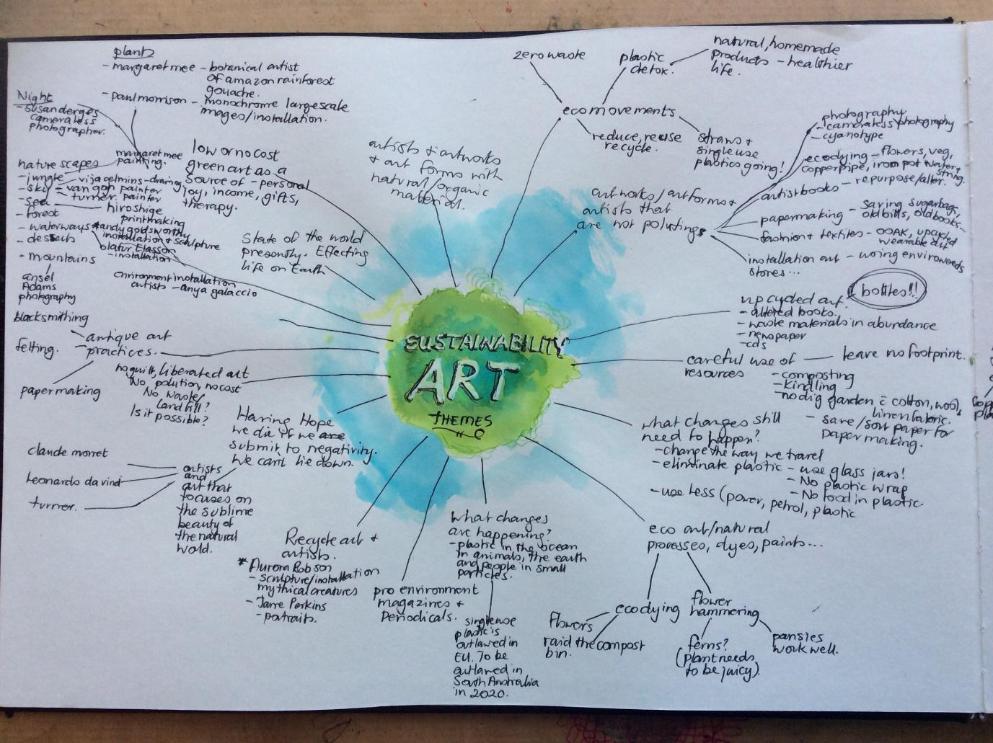
1. SUSTAINABILITY – MIND MAP IMAGE
We begin with a theme. When it comes to sustainability/the environment, what are you passionate and excited about, or outraged about and want to change?
- Make a class mind map on the board. Photograph it and glue it into your visual diary.
This activity addresses the below VCAA content descriptors for Year 9-10 Visual Art.
-
Explore the visual arts practices and styles as inspiration to develop a personal style, explore, express ideas, concepts and themes in art works (VCAVAE040)
2. ARTISTS OF INSPIRATION
In VCE studio arts, you will look at three different types of artists: historic, contemporary and cultural. In pairs, and with sustainability in mind, pick one historic, one contemporary and one cultural artist from the list below. Then pick two artworks from each artist. Present them to the class, providing the following information by writing it on the board.
- artists’ name
- dates of their life (birth, death)
- title of their artwork
- when it was made
- Materials used.
Differentiation
- Extending – look closely at an artwork you chose. What can you learn about brush strokes, pencil lines, construction of the artwork?
- Streamlining – create a small word document to clearly communicate your findings to the class. Print information or blow up on your device.
This activity address the below VCAA content descriptors for Year 9-10 Visual Art.
- Explore how artists manipulate materials, techniques, technologies and processes to develop and express their intentions in art works (VCAVAE041)
- Analyse, interpret and evaluate a range of visual artworks from different cultures, historical and contemporary contexts, including artworks by Aboriginal and Torres Strait Islander Peoples to explore differing viewpoints (VCAVAR046)
3. ARTFORMS AND MATERIALS
Look at the art forms mind map.

ACTIVITY –
- What can you add to it?
- What about the artworks you just looked at?
- Write your ideas in your visual Diary.
This activity address the below VCAA content descriptors for Year 9-10 Visual Art.
-
Select and manipulate materials, techniques, and technologies and processes in a range of art forms to express ideas, concepts and themes (VCAVAV042)
4. IDEAS AND INSPIRATION.
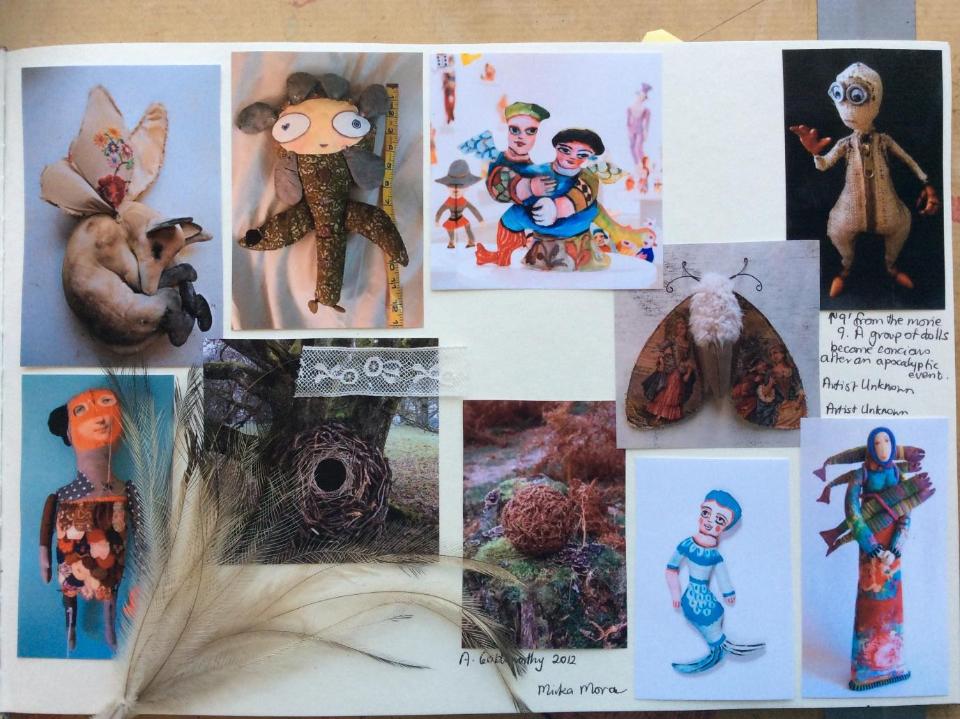
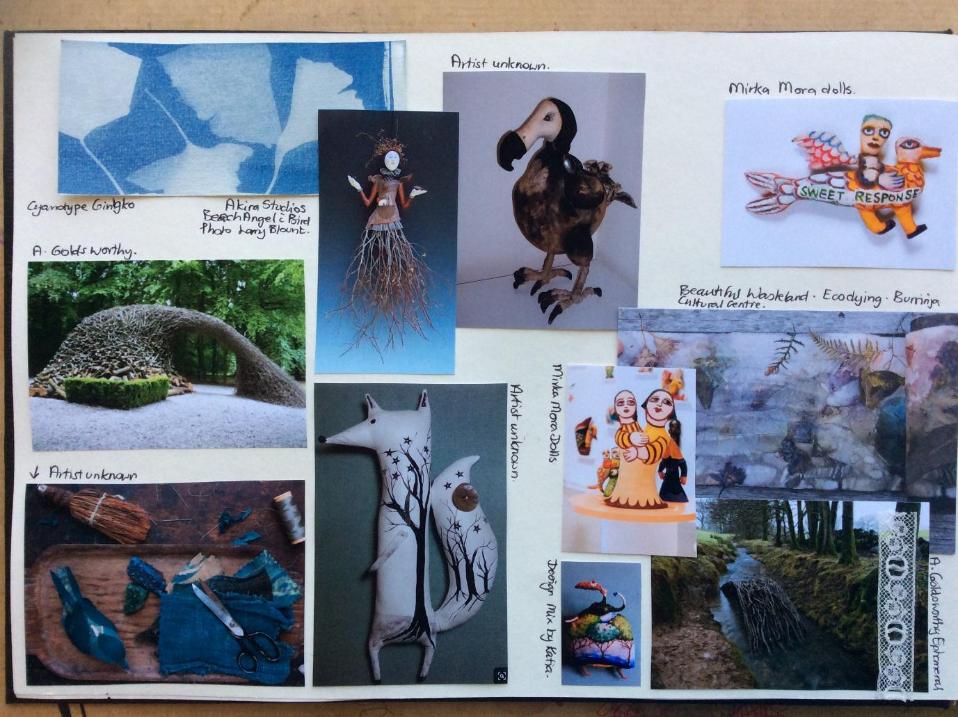
Below are two pages of images that I chose because they represent ideas I have and I find them inspiring. In studio arts, we represent our ideas by writing our thoughts and responses down, often next to images of inspiration or photographs of our creative process or artworks. We use words to describe our work and thoughts in interesting and sophisticated ways. This is called annotation. We will practice this as we work through the creative and written tasks below.
ACTIVITY –
- Choose one image from the page.
- Now look at the list of words below the visual diary pages. Some of these words will be familiar and some you might need to look up in a dictionary.
- Pick two words to describe the image you chose in two sentences. Aim to make your sentences sound interesting and descriptive.
- Try to avoid writing “I like/dislike this artwork’. Convey your response in a different way, for example ‘This artwork engages/ resonates with me’, or ‘this artwork disturbs/irritates/distresses me’. Always write what it is in the painting that causes this response in you.
WORD LIST -
- resonate
- juxtaposition
- convey
- nuance
- engage
- reconcile
- analogous
- object
- stylised
- hypothesise
- static
- inconsistent
- consistent
- subjective
- integrated
- genre
- method
- concept
- generate
- representation
- derive
- elicit
- pastiche
- colour
- scheme
- chiaroscuro
- composition
- diptych
- assemble
Differentiation
- Extending – Make a list of words you like and want to use regularly in your annotations.
- Streamlining – Look at the colours in the artwork you chose. Write down what they remind you of or how they make you feel.
5. MEDIA, MATERIALS AND TECHNIQUES
Now we are going to undertake Art Activities where you will get to make a small art work while experiencing a variety of art media, materials and techniques. At the end of these Art Activities you will be able to compile an artist's’ book.
ARTIST BOOK PAGES 1, 2 AND 3 – GRAPHITE PENCIL DRAWING.
Art Activity 1 - Making
- Select an object from nature that you are drawn to or ‘engage with’. See the examples below. It could be as simple as a lovely leaf.
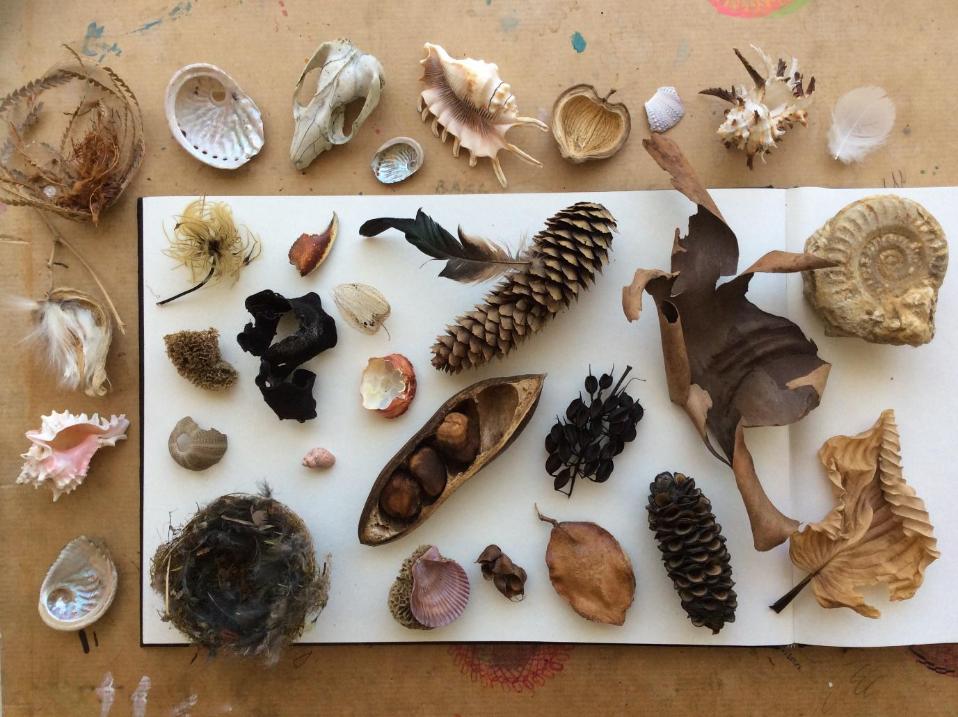
- Collect A4 size cartridge or water colour paper minimum 150 gsm (gsm stands for grams per square metre). Rip it in half. We are working in a small format as it is easy to finish the artwork in a lesson and it is a manageable space to fill. See photograph below for an example of page layout.
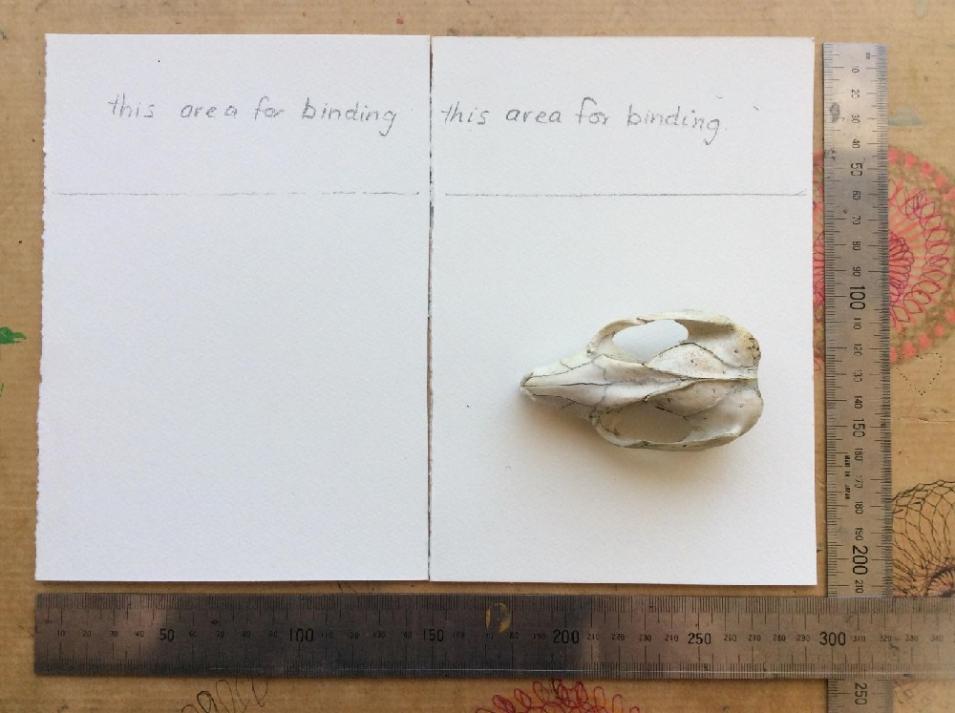
- Place your object on some white paper and photograph from different sides for reference. You could take close ups too. These images will be used later.
- First art task. We are going to produce three observational sketches with graphite pencil. Before you start drawing, sit and look at your object for three minutes. In your mind, draw with your eyes every line and edge and bit of detail you notice. This help you to know your object very well.
- In the first drawing you will not being looking at the paper you’re drawing on. Your drawing should look quite abstract and possibly even unrecognisable. I wonder if this is how some abstract artists achieve their images. You can add to your drawing later.
- In the second drawing you can look at the paper but you must use your unfavoured hand. Again, your artwork may look a little messy. Embrace the vulnerability in producing an artwork that is a little out of control.
- In the third drawing, you can use your favoured hand and look at the paper. By this time you will know your object well and will draw it with understanding.
Annotation - Responding
- Read the Art Elements listed in the below link.
https://www.vcaa.vic.edu.au/Documents/vce/art/Art_StudioArts%20_elements_principles_resource.docx
- Use two art elements to describe your drawing(s) and write thisnext to a printed photograph of your artwork.
Differentiation
- Extending – try using a pencil in each hand and drawing your object with both.
- Streamlining – Complete drawing 1 and 3.
Potential direction
-
Note down two possible ways you could develop what you have learnt in an artwork. Write the ideas in your visual diary next to your printed photograph of your art work.
This activity addresses the below VCAA content descriptors for Year 9-10 Visual Art.
- Select and manipulate materials, techniques, and technologies and processes in a range of art forms to express ideas, concepts and themes (VCAVAV042)
- Conceptualise, plan and design art works that express ideas, concepts and artistic intentions (VCAVAV043)
6. MEDIA, MATERIALS AND TECHNIQUES
ARTIST BOOK PAGE 4 – WATERCOLOUR AND COLOURED PENCIL.
Art Activity 2 - Making
-
Look at this artwork by John Wolseley.
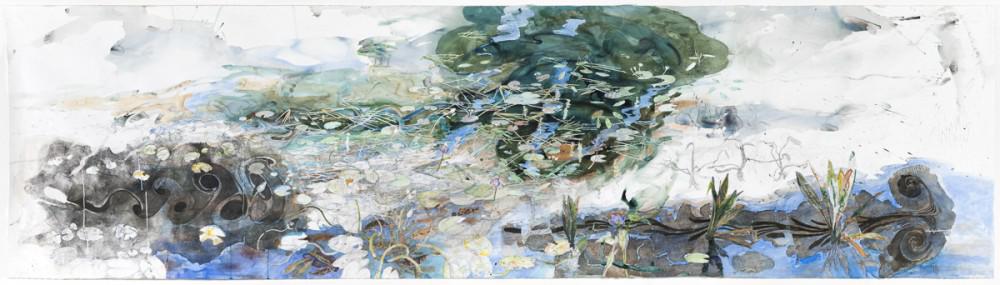
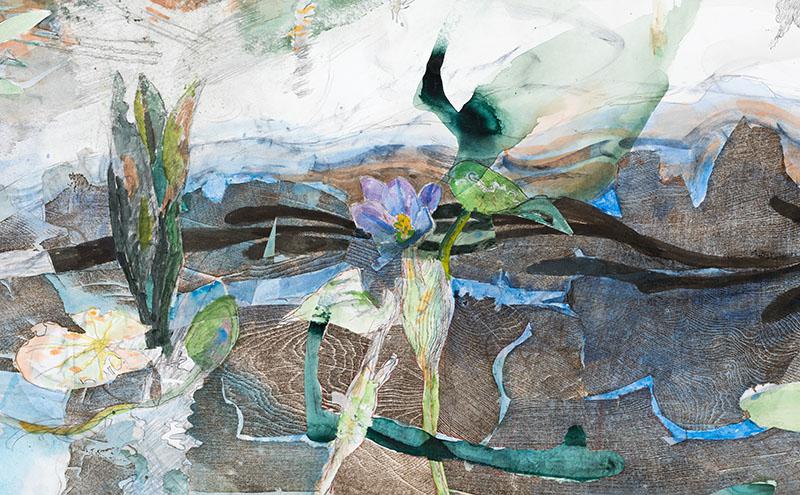
John Wolseley. ‘The life of inland waters – Durabudboi river’ full artwork and detail. 2015 – 2018. Watercolour, graphite, woodcut on paper. 124cm x 445cm.
Top: https://johnwolseley.net/exhibitions/the-life-of-inland-waters--Australian-galleries--Melbourne
- Set your object up in front of you, make sure you have enough light to see the detail of the object.
- Sketch in graphite pencil.
- Watch this video before applying a water colour wash.
https://www.youtube.com/watch?v=yl6V-gpkHOU
- Allow to dry.
- Once dry, add extra detail with sharpened coloured pencils.
Differentiation
- Extending - experiment with rock salt on wet watercolour.
- Streamlining – Choose two colours and experiment with the affects you can achieve.
Annotation - Responding
-
Read the Art Principles listed in the link below and write this next to a printed photograph of your artwork.
https://www.vcaa.vic.edu.au/Documents/vce/art/Art_StudioArts%20_elements_principles_resource.docx
-
Use two Art Principles to describe your drawing(s).
Differentiation
- Extending - experiment with rock salt on wet watercolour.
- Streamlining – Use ‘Emphasis’ and ‘Scale’ to annotate your artwork.
Potential direction
-
Consider two different ways you could develop an artwork with the media, materials and techniques you have used today. Write your ideas in your visual diary next to your printed photograph of your art work.
This activity address the below VCAA content descriptors for Year 9-10 Visual Art.
- Select and manipulate materials, techniques, and technologies and processes in a range of art forms to express ideas, concepts and themes (VCAVAV042)
- Conceptualise, plan and design art works that express ideas, concepts and artistic intentions (VCAVAV043)
7. MEDIA, MATERIALS AND TECHNIQUES
ARTIST BOOK PAGE 5 - WAX CRAYON AND INK RESIST ART.
Art Activity 3 - Making
- Set your object up in front of you, make sure you have good light to see the detail of the object.
- Watch this video. https://www.youtube.com/watch?v=M62oRuelku8
- Sketch your object very lightly with a pencil.
- Use wax crayons in light colours to define the object where it is highlighted. Use more than one colour, be daring.
- When you’re happy with your crayon application, slowly add a tiny bit of ink. Move it around, add water or another colour of ink…
- Photograph your art work and print.
- Below is a wax crayon/ink resist artwork I made with a dear friend.
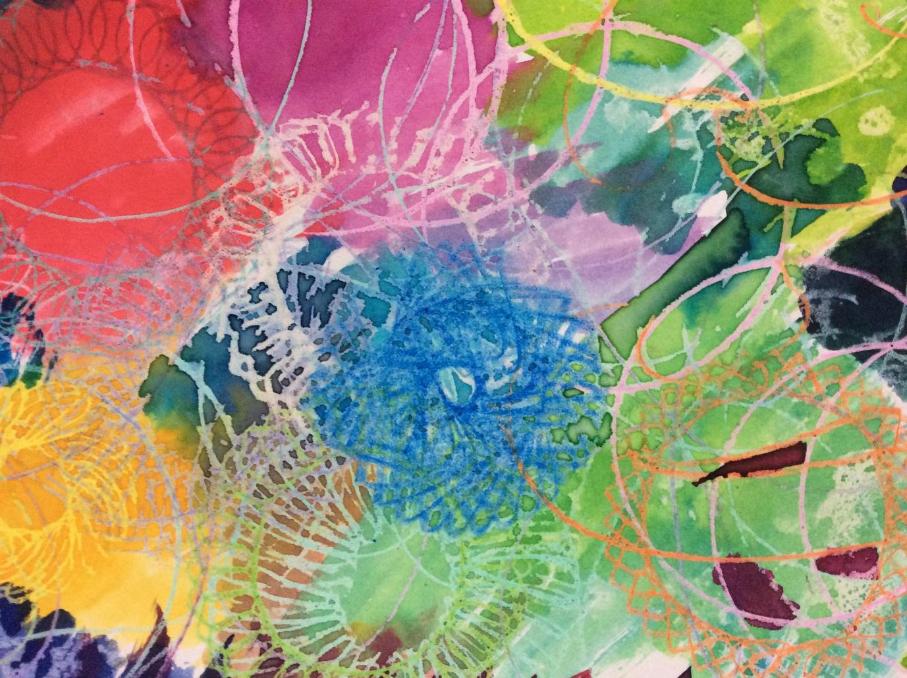
Annotation - Responding
-
Next to your printed photograph of your art work, discuss the aesthetic qualities of your work that is, how it makes you feel and what it is about it visually that achieves these feelings. Use Art Elements and Principles.
Potential direction
-
Consider two different ways you could develop an artwork with the media, materials and techniques you have used today. Write your ideas into your visual diary next to the printed photograph of today’s art work.
Differentiation
- Extending – Consider media that could be used to accentuate the fine detail, metallic paints, pen and ink?
- Streamlining – Use one white crayon to show where the light is shining on your object. Use a dark colour (black, brown, blue or purple) to show where the darkest shadows are. Pick an ink that is the colour of the object to paint the rest of it.
This activity address the below VCAA content descriptors for Year 9-10 Visual Art.
- Select and manipulate materials, techniques, and technologies and processes in a range of art forms to express ideas, concepts and themes (VCAVAV042)
- Conceptualise, plan and design art works that express ideas, concepts and artistic intentions (VCAVAV043)
8. MEDIA, MATERIALS AND TECHNIQUES
ARTIST BOOK PAGE 7 – CHARCOAL/CONTE PENCIL CONTOUR DRAWING.ON MIDGREY PAPER
Art Analysis – Responding
-
Look closely at this exquisite drawing by Albrecht Durer.
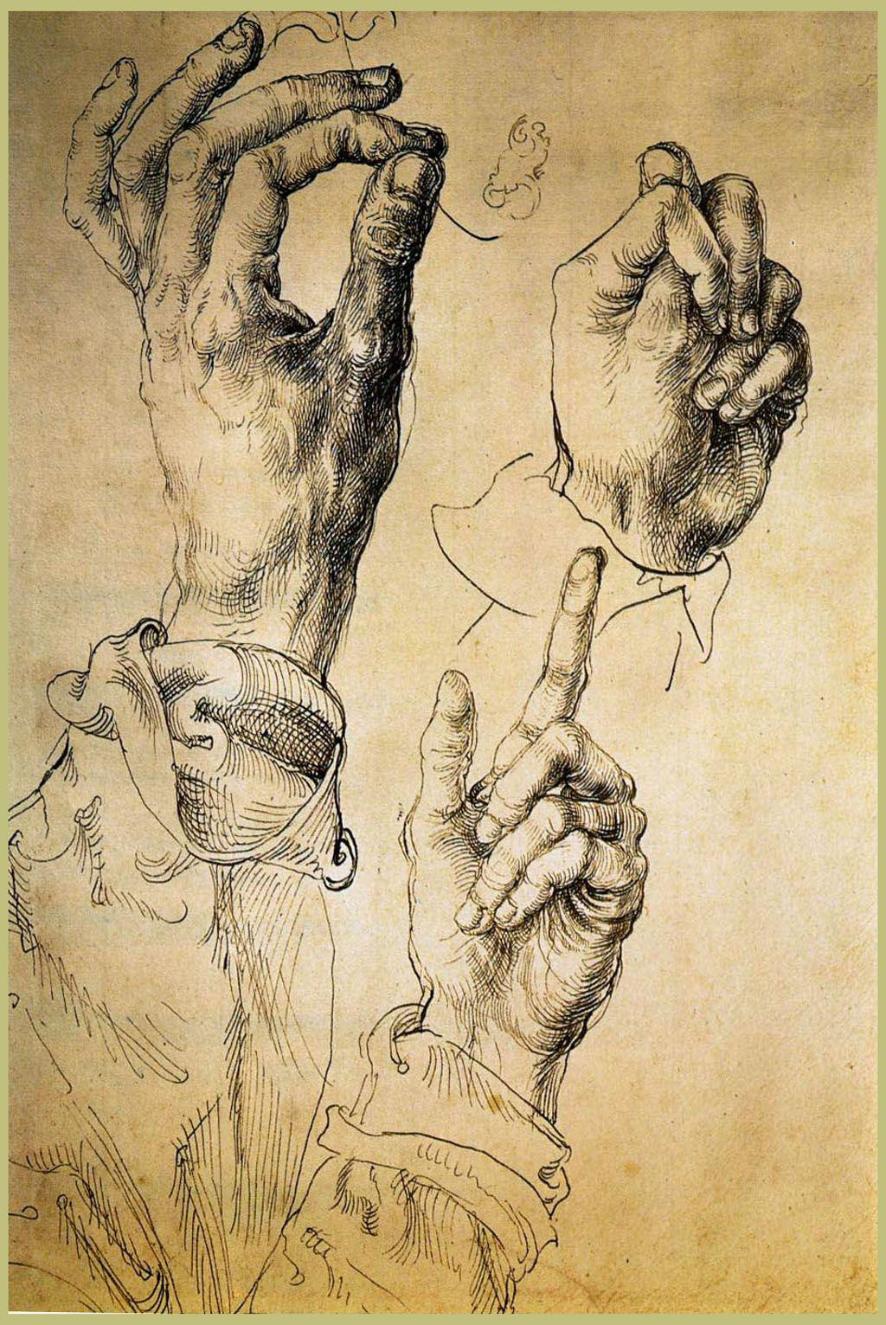
Albrecht Durer. Study of Three hands. 1513. Pen and ink on paper.
- What do you notice about the way he used ‘line’ to show, or ‘convey’, the 3D ‘form’ of his subject?
Art Activity 5 – Making
- On a mid-tone coloured paper (Choose a colour that is the main tone of your object) sketch your object very lightly in pencil.
- With a white and a black, brown or rust coloured charcoal pencil, slowly add the shading lines following the shape of your object wherever it has shadows.
- Add the white charcoal pencil where it is highlighted.
Potential direction
-
Consider two different ways you could develop an artwork with the media, materials and techniques you have used today. Write your ideas into your visual diary next to your printed photograph of your art work.
Differentiation
- Extending – Examine Da Vinci’s and Michel Angelo’s treatment of hair. Photograph one of your peers and have a go!
- Streamlining – sketch your object in pencil very lightly. Outline the bottom in a dark colour where the shadows are. Where the light is shining on it, outline your object in white. What other detail can you see? Think about which pencil you need to use to add this detail.
This activity address the below VCAA content descriptors for Year 9-10 Visual Art.
- Select and manipulate materials, techniques, and technologies and processes in a range of art forms to express ideas, concepts and themes (VCAVAV042)
- Conceptualise, plan and design art works that express ideas, concepts and artistic intentions (VCAVAV043)
9. MEDIA, MATERIALS AND TECHNIQUES
Art Activity 6 – Making
- You can use eucalyptus oil to transfer laser photocopied images onto a page of your artist book. Once it istransferred and dried, we will embellish the image.
- Collect one of your photographed, printed images from activity one, eucalyptus oil, a teaspoon and some smooth or light tooth paper, then watch the below video
https://www.youtube.com/watch?v=V7oLfLS1ohc
- Transfer your image onto your A5 paper. And allow to dry.
- Look at the image below by Del Katherine Barton and her use of detail in the negative space.
ARTIST BOOK PAGE 8 – USING EUCALYPTUS OIL FOR TRANSFER OF PHOTOCOPIED IMAGE, FOLLOWED BY NEGATIVE SPACE EMBELLISHMENT
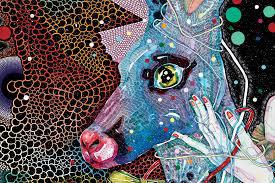
Del Katherine Barton. 2015. Acrylic on French Linen. ‘The Highway is a Disco’.
- Fill the entire background, or negative space of your art work, with pattern and detail.
- Use fine liner pen, gel pens and/or metallic pens.
Differentiation
- Extending – Carefully and subtly work graphite pencil detail into the transferred image.
- Streamlining – Fill the entire background in with dots gradually getting smaller as they get further away from your object. Over work the black dots with a gold dot, perhaps be selective.
Potential direction
-
Consider two different ways you could develop an artwork with the media, materials and techniques you have used today. Write your ideas into your visual diary next to your printed photograph of your art work.
Analyse and evaluate - Responding
-
Consider the art elements and art principles and aesthetic qualities of this art work you have just produced. How will it be interpreted by an audience?
This activity address the below VCAA content descriptors for Year 9-10 Visual Art.
- Select and manipulate materials, techniques, and technologies and processes in a range of art forms to express ideas, concepts and themes (VCAVAV042)
- Conceptualise, plan and design art works that express ideas, concepts and artistic intentions (VCAVAV043)
- Create, present, analyse and evaluate displays of artwork considering how ideas can be conveyed to an audience (VCAVAP044)
EXTRA MEDIA, MATERIALS AND TECHNIQUES
Here are some art activity suggestions if you would like to make extra pages for your artists’ book.
- On the page of an old paper back novel, sketch your object. Paint around the outside of your object with watered down acrylic paint. Allow to dry. Use fine liner pen to indicate the detail. Use gold or copper leaf or metallic paint for the fine detail.
- Using a magnifying glass or one of your close up photos for reference, produce a close up pencil sketch on brown paper. Fill in the negative space with carefully chosen collage.
- Using one of your photographs as reference, trace your image onto vellum with pencil. Hole-punch some of the details on the object. Lay over contrasting patterned or plain paper.
- On a piece of foam board, etch your object. Using a roller and printing ink, produce a print. Hand colour or add detail with a pen.
Below are three art forms I explored:
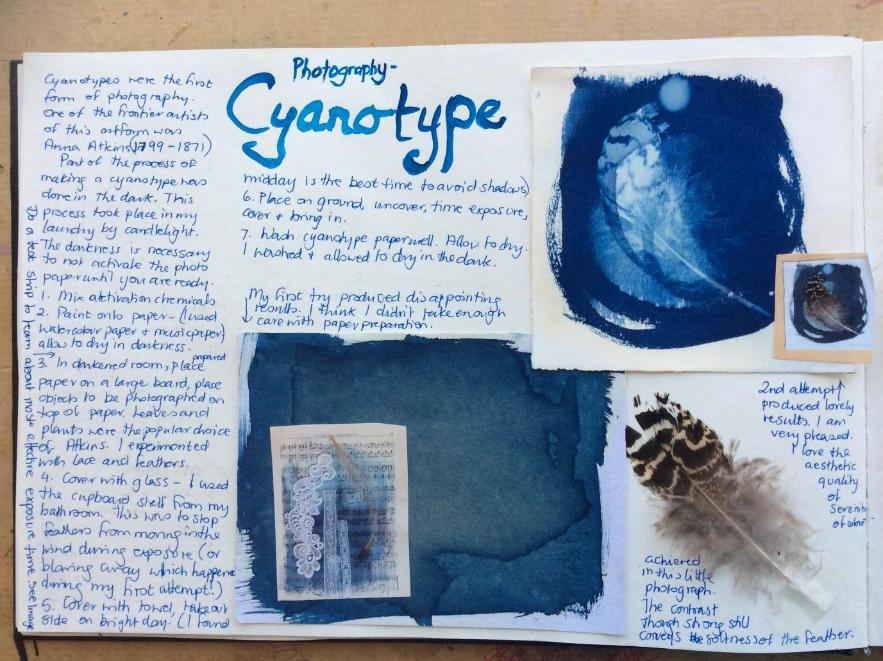
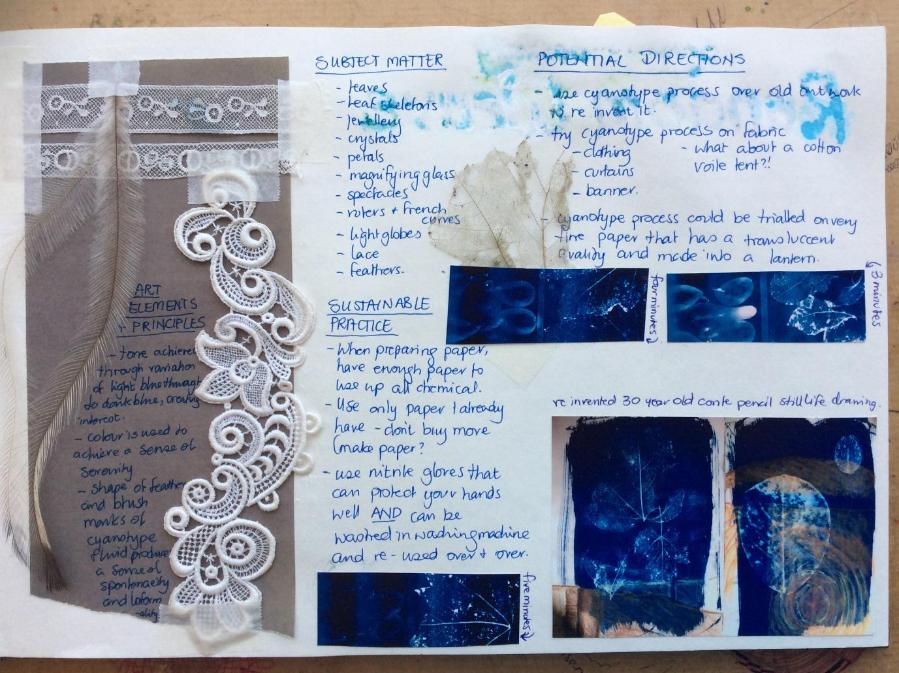
1. CYANOTYPE PHOTOGRAPHY
I found there is a lot of chance in the process of cyanotype photography. It was frustrating when I had set everything up correctly and I over exposed the paper or my objects moved during exposure or it didn’t work at all. I refined my process as I went along and reminded myself that I can always use the failed paper in a different way.
I have included sustainable practices and potential directions of extending this artwork process.
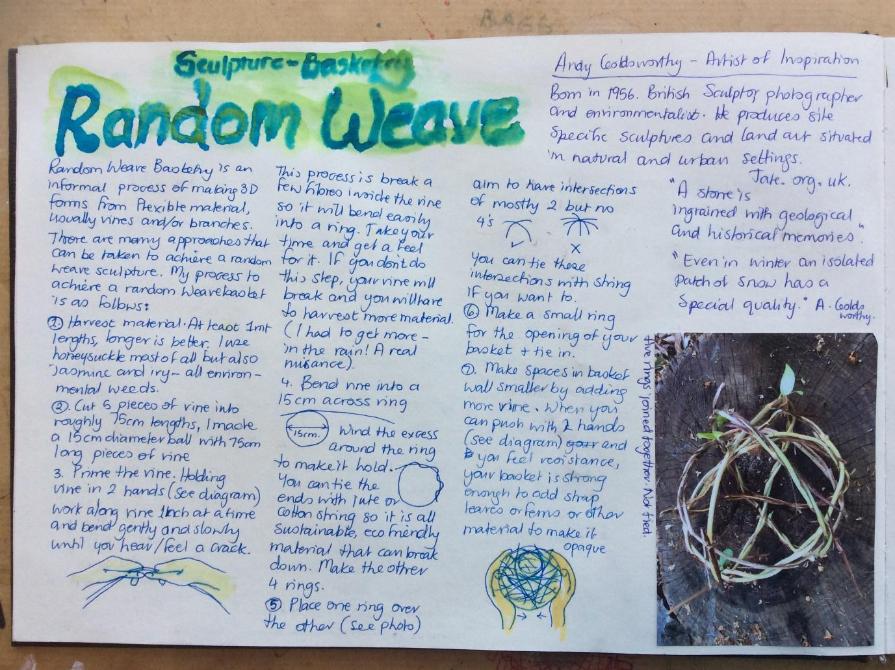
2. RANDOM WEAVE BASKETRY
I love the idea of removing environmental weeds and making art with the material. The techniques for producing random weave basketry are quite simple, there’s not a lot to know but once you know the steps, the scope for art making is vast and pretty much costfree as you only need string and vines.
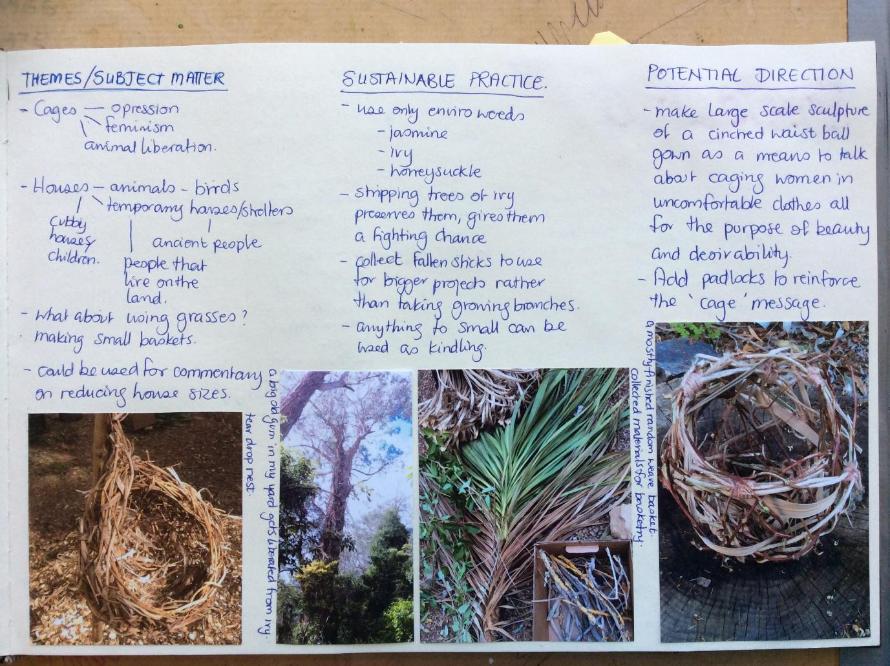
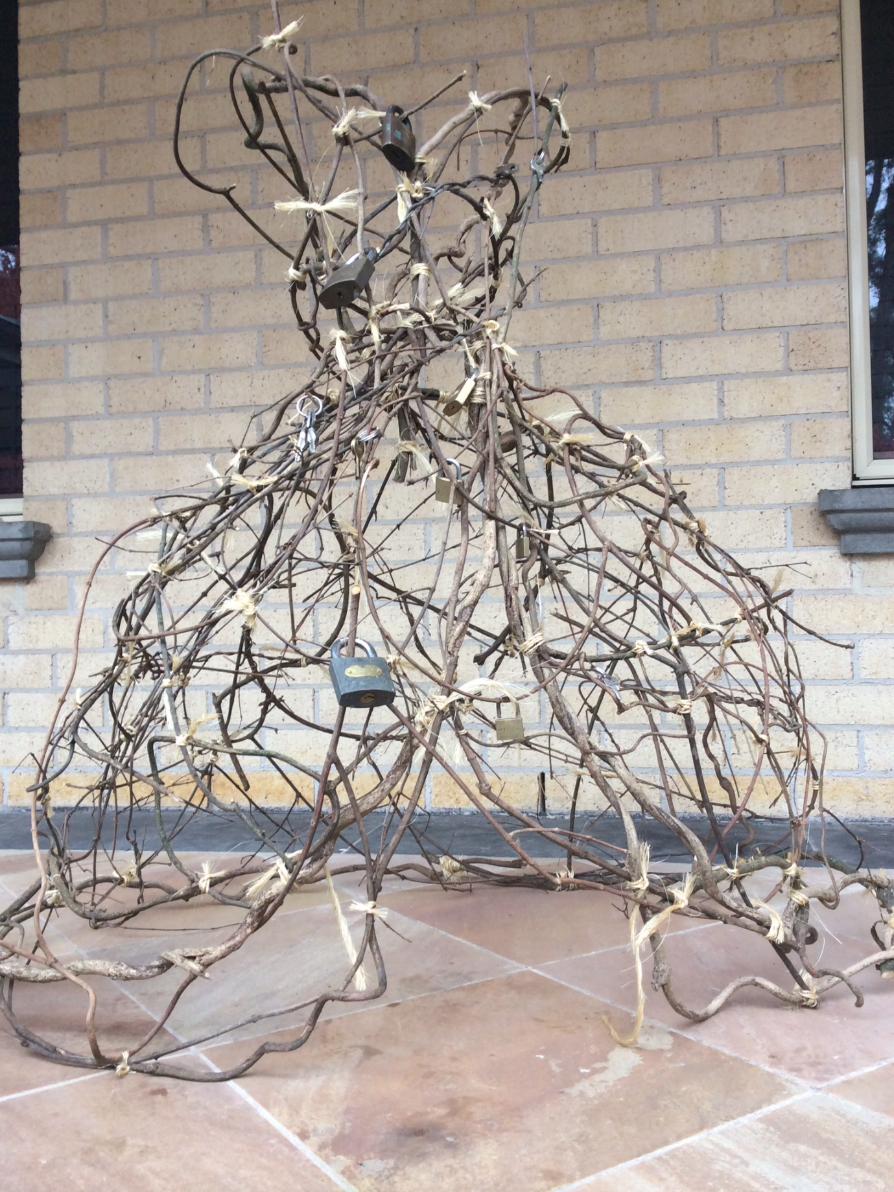
Here is a photography of a sculpture I made that has a theme of feminism. The artwork is a ball gown with a cinched waist that is also reminiscent of a cage. To further emphasise this, I attached padlocks to the front of the dress.
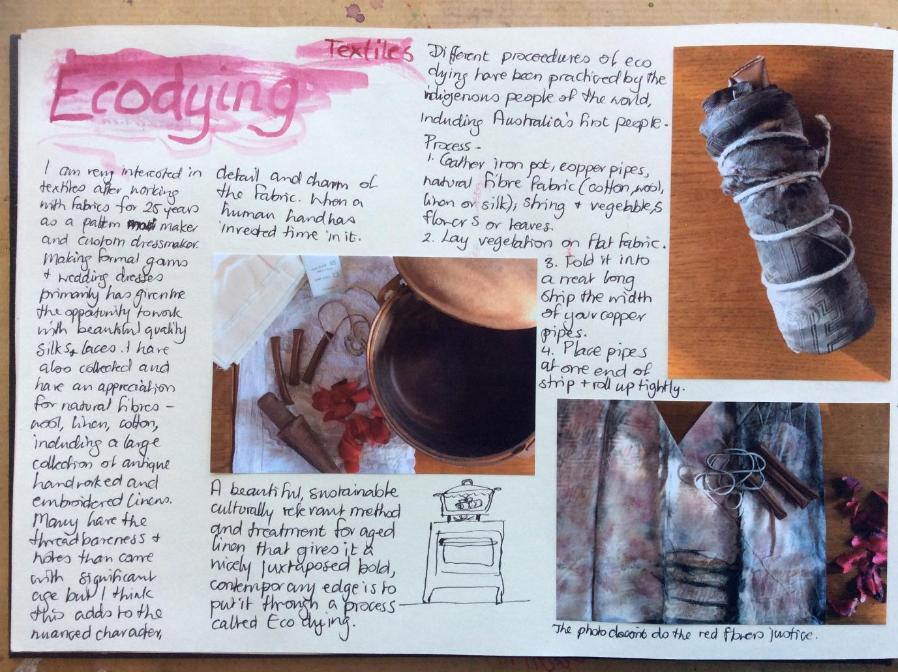
3. TEXTILES – ECO DYING AND SOFT SCULPTURE DOLL MAKING
Eco dying appeals to me very much as there is literally no expense to make art with this method. You collect plant matter, lay it on fabric made of natural fibre, roll it up tightly around some copper pipes, tie it up, boil it for an hour and hey presto! You have dyed your fabric with organic material that can go on the garden for mulch or in the compost bin. There is a fair amount of chance with this process, which you need to embrace to enjoy this.
On the last page of my journal, I was considering soft sculpture as a form of textile art. Mirka Mora, a renowned artist, produced many intriguing soft sculpture dolls. I would further explore her creative process to make a doll as a final artwork. This art work would engage the audience and address the need for a sustainable mindset and the associated lifestyle changes, through its story, and the detail in the materials with which it is made.
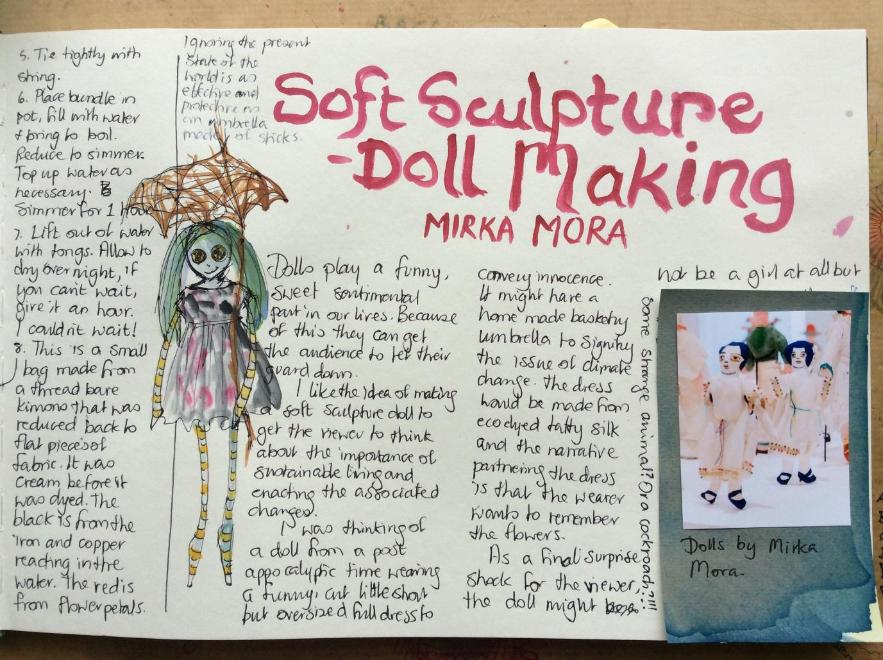
FINAL ARTWORK IDEA:
I will make a soft sculpture doll with a dress made from eco dyed fabric as a way of enjoying and remembering the flora of the world. She will have a basketry umbrella as a symbolic acknowledgement of climate change. She will be stuffed with natural material and her body will be made from cotton, her hair will be wool. When the time comes, she could be returned to the earth without causing any damage.
© Copyright Ingrid Schmidt