Year 11 Unit 1 Area of Study 1 Annotated Creative Process and Learning Sequence
Research and Recording Ideas
Resource and Support Material.
Below you will find the annotated Visual Diary pages detailing my recorded research and findings that are the first step of my creative process specified by the VCE studio arts Study Design for unit 1 outcome 1, pg. 12 – 13. See the document below for specific details. https://www.vcaa.vic.edu.au/Documents/vce/studioarts/StudioArtsSD-2017.pdf
I began my exploration with an interest in Prehistoric art. I sought to interrogate the artwork of humanity’s first artists, hoping to gain insight into what motivated them to make markings on walls of caves, the only two dimensional surface available to them to extend themselves creatively. I wanted to examine their art in the hope of learning what their thought processes where at the time of their art making, what they chose to draw or paint and why, what they chose to use to make art, what their techniques were and how they were invested intheir subject matter and how they felt when they were actually producing the artwork.
My recorded creative process is not completely chronological as I often feel excited and overwhelmed with a sense of urgency to gain answers to my inquiry. I find the best method for me to resolve an artwork is to begin wherever my imagination takes me.
I used the directions available to VCE Studio Arts students as outlined in the text book Studio Knack, (Gilligan and Grant, 2016, Pg. 5 -17). Information on page one was added to during the research process as it became available.
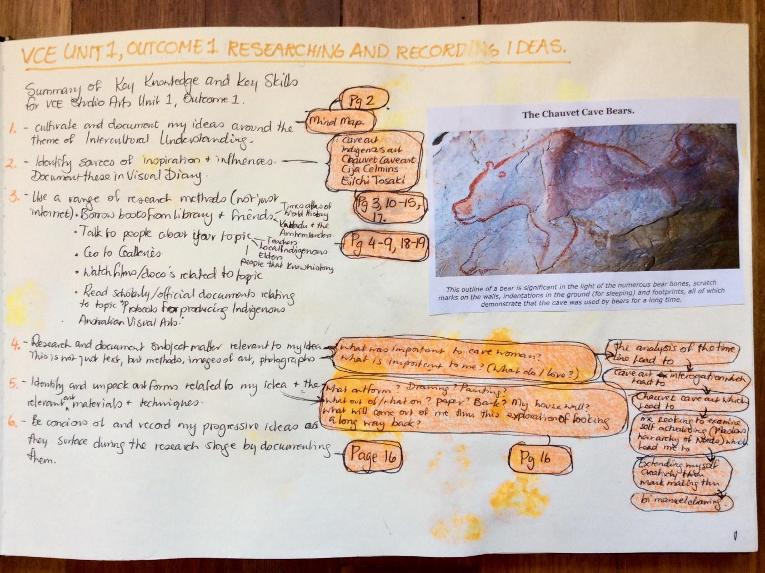
1.Cultivate and document my ideas around the theme of Intercultural Understanding.
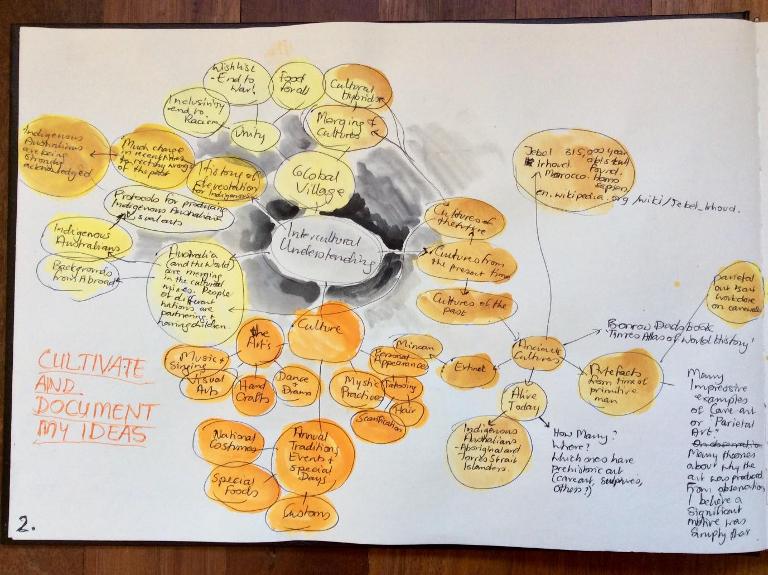
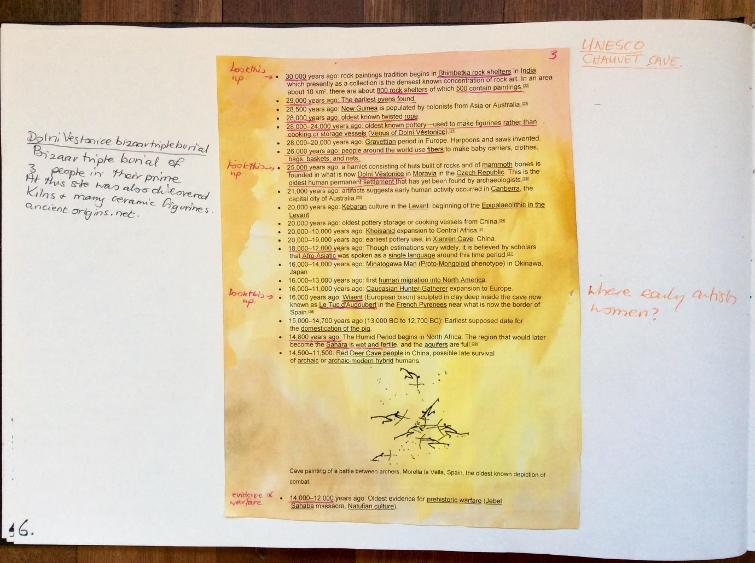
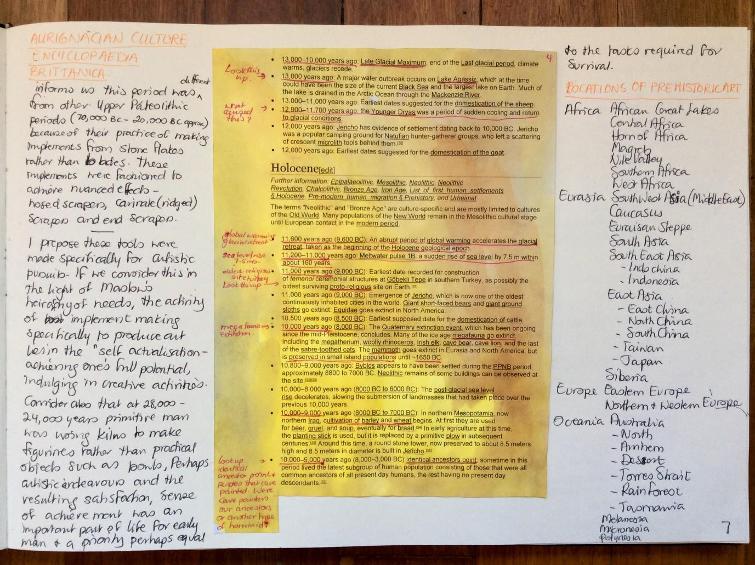
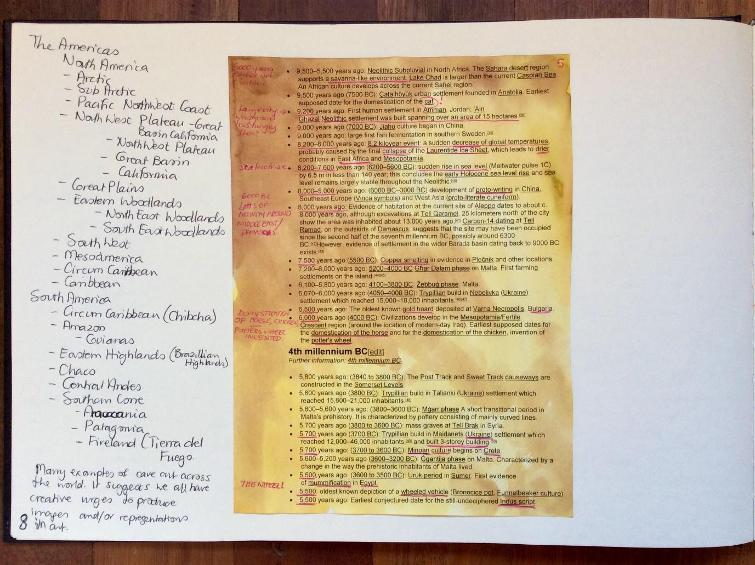
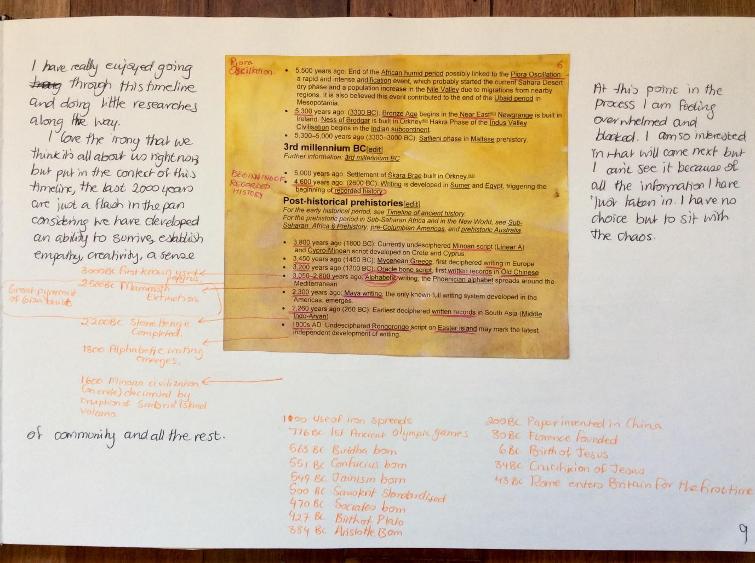
I began with a mind map with the intention of ordering my thoughts and with the expectation that extra ideas and insights would surface. Toward the end of this phase, I felt the most effective action to take to gain understanding of the living circumstances of ancient artists was to examine a time line of ancient history. This is detailed on pages 3 – 9.
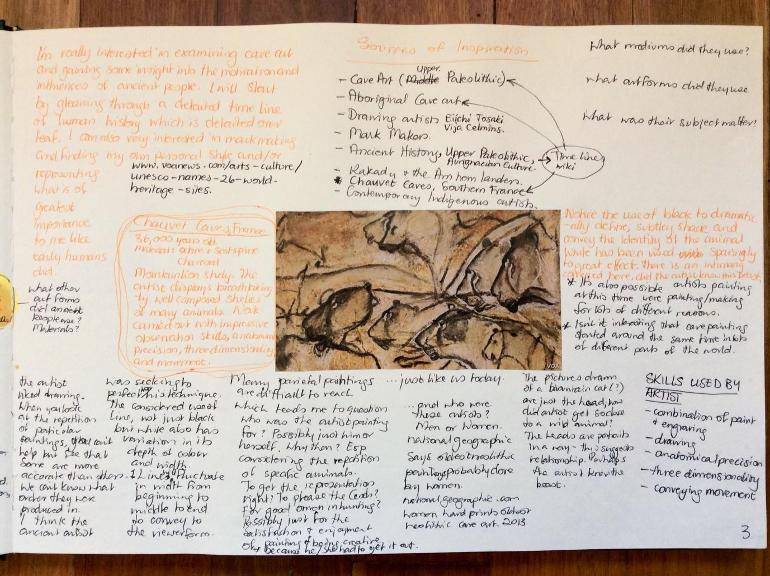
2. Identify sources of inspiration and influences. Document these in your visual diary.
Making –
Look at this website,
https://www.studentartguide.com/articles/inventive-mixed-media-techniques
Choose a method and replicate it.
Responding –
Go to https://japingkaaboriginalart.com/articles/aboriginal-art-symbols/ .
Choose an artwork, discern which art elements and art principles have been used, and explain your findings and your thoughts to a peer.
3. Use a range of research methods.
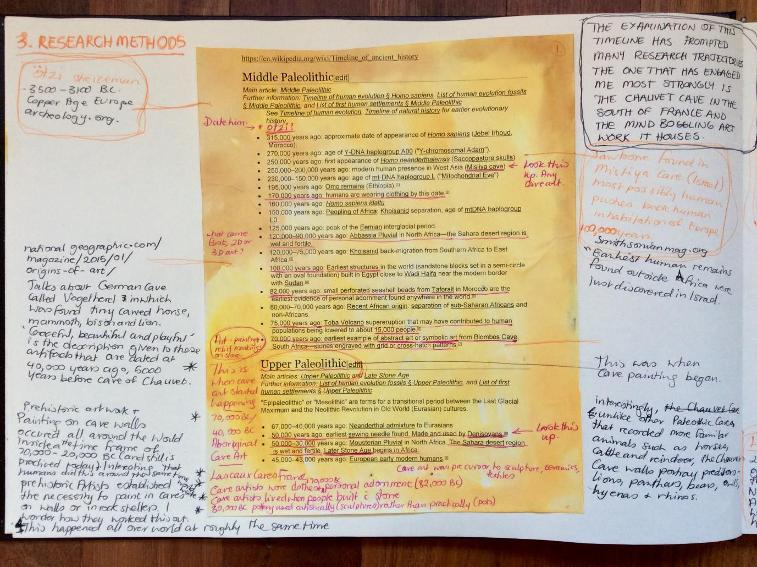
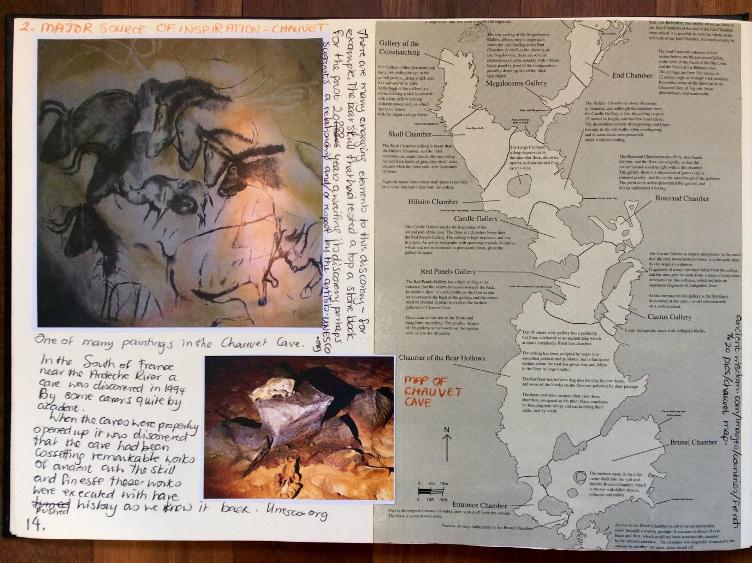
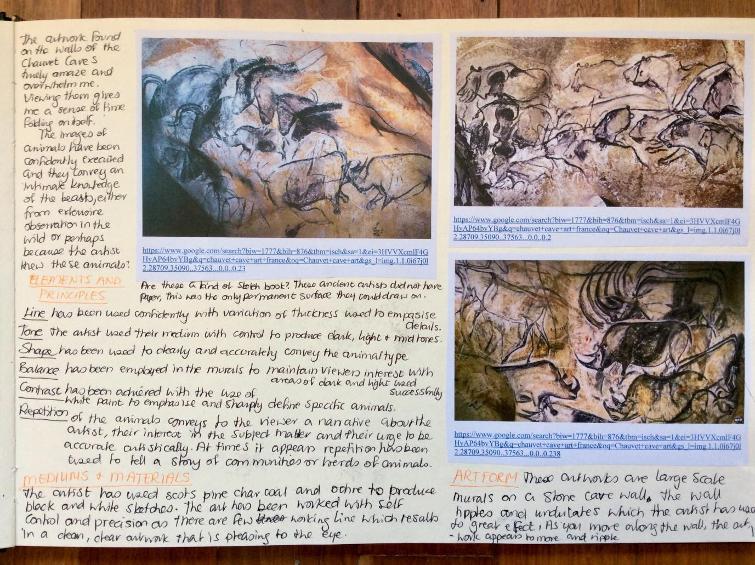
The timeline provoked many search trajectories particularly of specific cave art sites around the world. The artwork of one in particular, Chauvet cave, engaged me strongly.
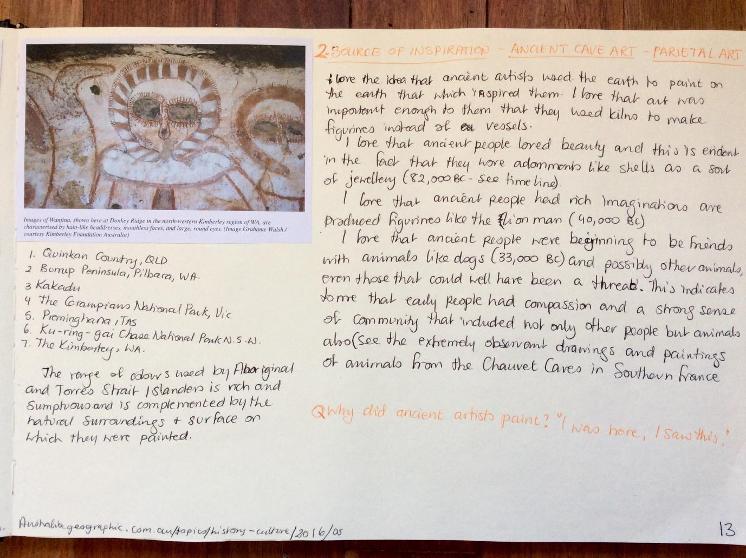
As I worked through the timeline, I noticed the order in which certain things happened gave me insight into the lives of ancient people. For example, at one point (28,000 – 24,000 BC), the timeline states that pottery was used, not so much to make cooking pots but figurines. The timeline also revealed information like adornments of shells were worn, early people where possessing things they found pleasing and engaging, they appreciated beauty in the world around them.
Maslow’s Hierarchy of Needs (McLeod, S. A, 2007) also played a part in my understanding about ancient artists. After observing the artwork in the Chauvet Cave, I can’t help wondering if the artists were in a developmental place of self-actualisation.
I found a list of all the countries that have prehistoric cave art examples. It was intriguing that prehistoric cave was produced in a fairly specific timeframe in human history across the planet. It seems our ancestors were developmentally ready.
Making –
Do the three part observational drawing activity below to improve your sketching ability which will be useful for when you are planning and recording your findings.
- Set up a glass vase or jar with a large leaf or branch in it.
- 2. For 1 minute, look at the still life, draw every line in your head.
- 3. Now put pencil to paper and without looking at the paper, draw as your eye traces over every line in the still life,. This is supposed to look inaccurate or distorted.
- Now, draw what you see, this time you are permitted to look at your paper.
This exercise will help you observe and draw more accurately.
Responding –
Read pg. 14 – 15 of Studio Knack which details research methods. Discuss with a peer ideas for effective researching.
4. Research and document subject matter relevant to my idea.
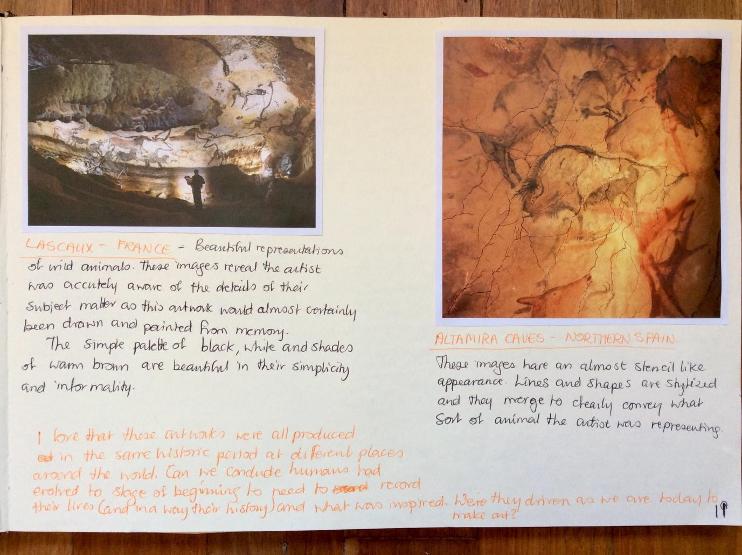
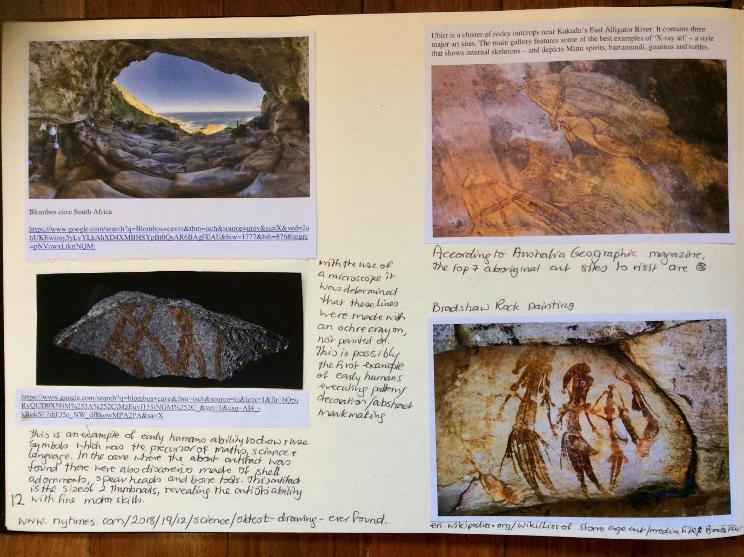
The timeline prompted specific areas to refine my research from the Upper Palaeolithic period in human history. Pages 10 – 15 provide more detail of specific cave art artefacts from South Africa, Australia, Spain and France. I discovered subtle nuances between these beautiful earthy artworks. Ancient artists had wonderful, interesting ng imaginations and they took pride in their art making and it appears they enjoyed the process.
As previously stated, the breathtakingly beautiful artwork housed in the Chauvet cave particularly engaged me. Much of my attention was given to examining and reflecting on these artefacts and the artists that produced them.
I commented in my visual diary that I love the notion of this art being produced with the earth (pigments and oxide paint0 on the earth (rock and cave walls) like artistic geysers that have surfaced to remind and inform us of what was enjoyable and important to early artists. These artefacts tie together below ground through the earth that interconnects the artwork and the ancient artists and us presently, and in a way, folding away the time that has passed between their existence and ours.
Making –
Google search ‘Chauvet cave art’. Examine ancient cave art paying special attention to the marks made. Replicate the cave artists’ marks or develop your own.
Responding –
Annotate a piece of cave art. Use some or all of the following words in your annotation: Aesthetic qualities, engage the audience, cultural or historic context, authenticity, figurative art, expression, analysis (see glossary in Art-isan, 2016, pg. 276-277).
5. Identify and unpack art forms related to my idea and the relevant art materials and techniques.
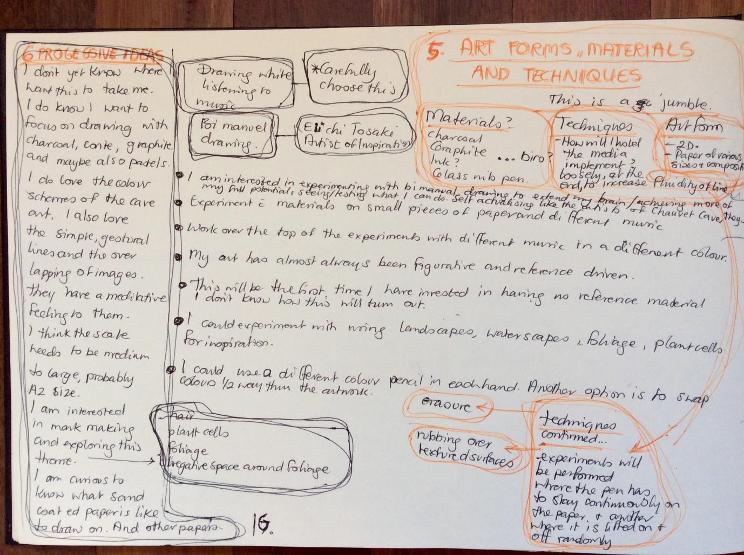
I found I was feeling quite overwhelmed by where to take my findings. I decided to write down what I did have clarity about. This was listed under the heading of ‘Progressive Ideas’ on page 16, to the left of the image below. As I committed my thoughts to paper, a skeleton of a creative plan emerged and direction became clear. A variety of tasks and experiements will be performed with the intention of me achieving the full potential of what I am presently capable of as the artists of Chauvet cave (in my opinion), had done at the specific time in their life that produced the artwork in that cave.
Photograph materials and papers
Making –
Watch this Bimanual Coordination Drawing video.
https://www.youtube.com/watch?v=UMlJ_wLC4XI&list=PL9FD5978F0C5E698B&index=2
And then give it a try.
Responding – List all the art forms you can think of. Collaborate with your peers to make a poster for the art room wall and refer to it during your creative process, particularly while media trials.
6. Be conscious of, and record my progressive ideas as they surface during the research stage by documenting them.
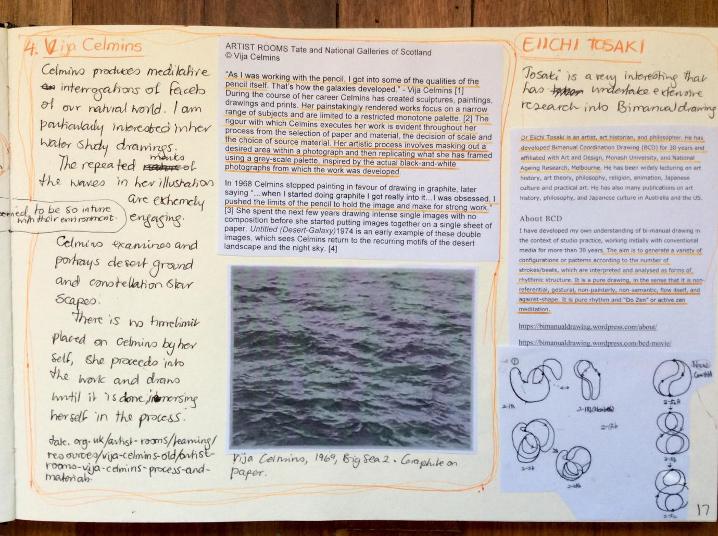
I researched a number of artists that are renowned for drawing and mark making including, Cy Twombly, Terry Winters, Jenny Saville and Joseph Stashkevetch. I settled on the artists Cija Celmins and Eiichi Tosaki as my artists of inspiration. Celmins is quite meditative in her approach and she extracts everything that is possible from a pencil. Tosaki developed a drawing technique called Bimanual Coordination Drawing (BCD), where a pencil or brush is held in each hand and each hand moves differently. Details of their practice and process can be found on page 17.
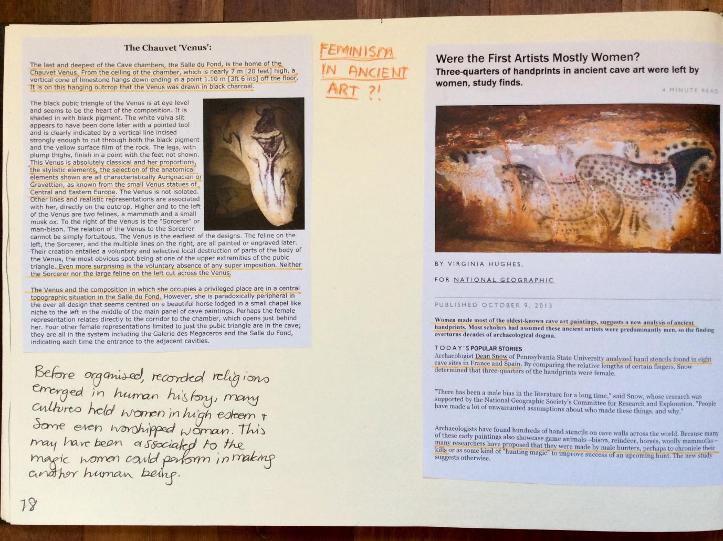
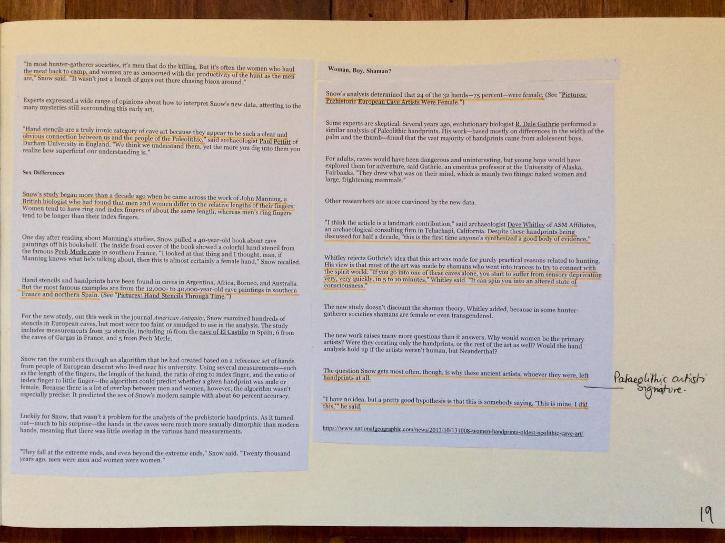
Pages 18 and 19 contains two articles. The Chauvet Venus discusses one of the artworks of the Chauvet cave that appears to be housed in a cave room that could be seen as a kind of temple or holy place. The artwork found there acknowledge the importance of Woman.
The second article is from National Geographic and is titled ‘Were the First Artists Mostly Women?’ which I found very interesting, especially considering it has been fairly widely assumed that prehistoric artists were men. It is based on a scientific examination of the size of the stencilled hands found at many prehistoric cave art sites around the world.
Making –
Watch this link.
https://www.youtube.com/watch?v=2k2OYRGrdWE
Have a go at erasure art.
Responding –
Read the National Geographic article on the link below (it’s a 4 minute read).
https://www.nationalgeographic.com/news/2013/10/131008-women-handprints-oldest-neolithic-cave-art/
Check National Geographic for an article that might support your idea development.
© Copyright Ingrid Schmidt